Elevating Your Operations: A Guide to Specialized Warehouse Equipment.
Premise: The modern warehouse is no longer just a place for storage; it’s a dynamic, high-velocity nerve center for commerce. To meet the demands of e-commerce, just-in-time inventory, and increasing product variety, businesses must look beyond traditional solutions. This requires understanding that a one-size-fits-all approach to material handling is inefficient. True optimization comes from deploying specialized equipment designed for specific tasks, moving beyond the familiar workhorse—the counterbalance forklift—to embrace tools like reach trucks & order pickers that master the unique challenges of high-density storage and individual item retrieval.
Introduction
For decades, the image of a warehouse has been synonymous with the counterbalance forklift—a rugged, versatile machine diligently moving pallets from receiving docks to storage racks. This iconic piece of equipment has been, and continues to be, the backbone of countless industrial operations. It excels at loading and unloading trucks, transporting goods over moderate distances, and stacking pallets in standard racking systems. However, as warehouse footprints become more expensive and the pressure to store more goods in the same amount of space intensifies, the limitations of this traditional design become apparent. The wide chassis and turning radius of a standard counterbalance forklift necessitate wide aisles, consuming valuable floor space that could otherwise be used for revenue-generating inventory.
This is where the evolution of material handling equipment takes a critical turn. To conquer the modern challenges of vertical space and granular order fulfillment, warehouses are turning to a more specialized fleet. This article, “Beyond the Counterbalance,” serves as an introduction to two of these key specialists: the reach truck, a master of the narrow aisle and towering rack heights, and the order picker, a revolutionary tool designed to bring the operator directly to the product for fast and accurate piece-picking. By understanding the unique capabilities of these machines, warehouse managers can unlock new levels of efficiency, density, and productivity. But before we delve into these specialists, it is essential to first understand the technological foundation upon which they are built. The modern, advanced counterbalance forklift itself has evolved dramatically, and its features—particularly in electric, lithium-powered models—provide the baseline for the technology we now see in its more specialized cousins.
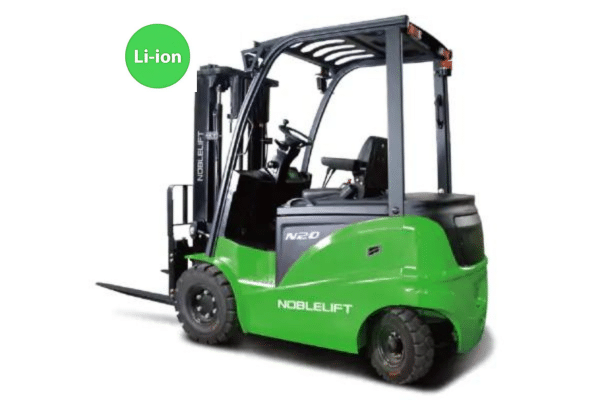
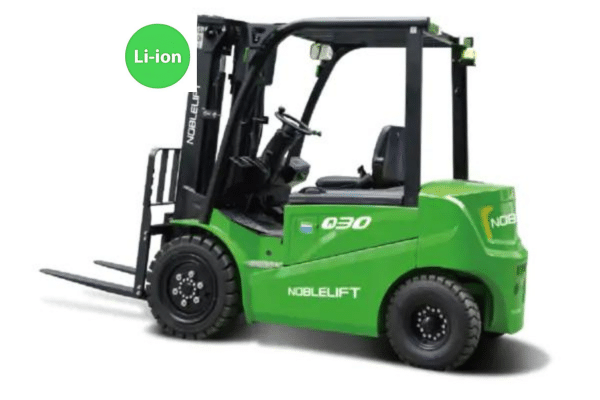
The Modern Foundation: 10 Core Features of an Advanced Electric 4-Wheel Lithium-Powered Forklift
To appreciate the specialized advantages of reach trucks & order pickers, we must first recognize the immense progress made in the foundational workhorse: the 4-wheel counterbalance forklift. The shift to electric power, specifically with lithium-ion technology, has redefined what these machines can do. Here are ten cornerstone features of a modern electric 4-wheel lithium-powered forklift that set the stage for today’s high-performance material handling equipment.
1. Game-Changing Lithium-Ion (Li-ion) Power Source
The single most transformative feature is the adoption of lithium-ion battery technology. Unlike traditional lead-acid batteries that require long charging cycles, battery swapping, and constant maintenance like watering, Li-ion batteries offer a completely different operational paradigm. They are a sealed, maintenance-free power source that delivers consistent power from 100% charge down to empty. This eliminates the “voltage sag” common in lead-acid batteries, where the forklift becomes sluggish as the battery drains. The technology enables rapid “opportunity charging”—plugging the forklift in during short breaks, like lunch or a shift change—without harming the battery’s lifespan. This effectively keeps the forklift operational for 24 hours a day with a single battery, eliminating the need for costly and space-consuming battery changing rooms.
- Opportunity Charging: A 15-30 minute charge during a break can provide hours of additional runtime, maximizing equipment uptime.
- Zero Maintenance: No watering, equalization, or cleaning of terminals is required, saving countless labor hours and eliminating the risk of acid spills.
- Longer Lifespan: Li-ion batteries can last 3-4 times longer than their lead-acid counterparts, offering a significantly lower total cost of ownership over the life of the forklift.
2. Unmatched Four-Wheel Stability
While 3-wheel forklifts are nimble, the four-wheel configuration provides a wider, more stable foundation. This is crucial for applications involving heavier loads, higher lift heights, and operation on slightly uneven surfaces or ramps. The four points of contact create a larger stability triangle (or more accurately, a trapezoid), giving the operator greater confidence when maneuvering with a full load at height. This inherent stability allows for higher residual capacities, meaning the forklift can safely lift heavier loads to greater heights compared to a similarly sized 3-wheel model. Modern electric 4-wheel designs have also significantly improved their turning radius, closing the gap on their 3-wheel counterparts while retaining their superior stability.
- Higher Residual Capacities: Safely lift heavier loads to maximum fork height.
- Enhanced Outdoor/Ramp Capability: More secure when moving between indoor and outdoor environments or navigating inclines.
- Operator Confidence: The feeling of a solid, planted machine reduces operator hesitation and can increase productivity, especially with heavy or awkward loads.
3. Zero-Emission, Clean Operation
A core benefit of any electric forklift is the complete elimination of harmful emissions. Internal combustion (IC) forklifts running on propane or diesel release carbon monoxide and other particulates into the environment. This is not only a concern for outdoor air quality but a major health and safety risk inside a facility. Electric forklifts produce zero localized emissions, creating a healthier and safer environment for all employees. This is particularly critical in industries like food and beverage, pharmaceuticals, and cold storage, where product contamination from exhaust fumes is unacceptable. The quiet operation also dramatically reduces noise pollution, allowing for easier communication on the warehouse floor and reducing operator fatigue.
- Improved Air Quality: Eliminates airborne pollutants, protecting employee health and preventing contamination of sensitive goods.
- Reduced Noise Pollution: Creates a less stressful work environment and makes it easier to hear warning signals and verbal instructions.
- Regulatory Compliance: Meets and exceeds indoor air quality standards and environmental regulations.
4. Advanced Operator-Centric Ergonomics
Modern forklift design places the operator’s comfort and safety at the forefront. A fatigued or uncomfortable operator is less productive and more prone to making errors. Advanced 4-wheel electric forklifts feature highly ergonomic compartments designed for long shifts. This includes a full-suspension seat to absorb vibrations, a low step height for easy entry and exit, and an adjustable steering column to fit operators of all sizes. The placement of controls is intuitive, with mini-levers or joysticks that reduce arm and wrist strain compared to old-fashioned cowl-mounted levers. Excellent all-around visibility is achieved through intelligently designed overhead guards and slim mast profiles, giving the operator a clear view of the load, the forks, and the surrounding environment.
- Reduced Operator Fatigue: Comfortable seating and intuitive controls allow operators to remain alert and productive throughout their entire shift.
- Enhanced Safety: A clear line of sight in all directions minimizes blind spots and reduces the risk of accidents.
- Increased Productivity: An operator who is comfortable and confident in their machine will naturally work more efficiently and with greater precision.
5. Drastically Lower Maintenance and Total Cost of Ownership (TCO)
An electric forklift has far fewer moving parts than an IC engine-powered one. There is no engine, transmission, radiator, or complex exhaust system to maintain. This means no oil changes, no filter replacements, and no spark plug tune-ups. The primary maintenance items are the electric motors, controllers, and hydraulics, which are generally more reliable and require less frequent service. When combined with the maintenance-free nature of a lithium-ion battery and the extended lifespan of components like regenerative brakes, the result is a significant reduction in both maintenance labor and parts costs. This leads to a much lower Total Cost of Ownership (TCO) over the forklift’s life, even if the initial purchase price is slightly higher.
- Fewer Serviceable Parts: Eliminates the need for engine oil, coolant, filters, and belts, saving time and money.
- Increased Uptime: Less time spent in the service bay means more time on the warehouse floor moving products.
- Predictable Budgeting: Maintenance costs are lower and more predictable compared to the frequent and sometimes unexpected repairs needed for IC engines.
6. Intelligent Regenerative Braking
Regenerative braking is a smart technology that turns the forklift’s own momentum into usable energy. When the operator releases the accelerator pedal or applies the brakes, the electric motor reverses its function, acting as a generator. It captures the kinetic energy that would normally be lost as heat in a traditional braking system and uses it to send a small charge back to the battery. This has two major benefits: it extends the forklift’s runtime per charge by up to 15%, increasing operational efficiency, and it dramatically reduces wear and tear on the service brakes, further lowering maintenance costs and downtime. This smooth, electronic braking also provides a more controlled and precise deceleration experience for the operator.
- Extended Runtime: Recaptures energy to prolong the operational period between charges.
- Reduced Brake Wear: The primary braking force is handled by the motor, saving the mechanical brakes for full stops and emergencies.
- Smooth and Controlled Operation: Provides predictable, automatic braking when the accelerator is released, enhancing safety and control.
7. Customizable Performance Parameters
Not every task or every operator requires the forklift’s maximum power. Modern electric forklifts come with advanced controllers that allow managers to program and customize performance parameters to match the application and the operator’s skill level. Top travel speed, acceleration rate, lift/lower speeds, and regenerative braking strength can all be adjusted. For example, a manager could set a lower top speed for a new operator or in congested pedestrian areas. In a long-run application, the acceleration can be set to be smooth and efficient to conserve energy. This ability to tailor the forklift’s performance ensures optimal safety and efficiency for every situation.
- Enhanced Safety: Limiting speeds and acceleration for novice operators or in specific zones can significantly reduce accidents.
- Application Matching: Performance can be optimized for long-distance transport, delicate load handling, or maximum productivity.
- Password Protection: Settings can be password-protected to ensure that only authorized personnel can make adjustments.
8. Superior Mast and Chassis Visibility
Safety is paramount, and visibility is one of its most critical components. Designers of modern 4-wheel electric forklifts have gone to great lengths to maximize the operator’s line of sight. This includes using slim-profile mast channels, strategically routing hydraulic hoses to the sides of the mast, and designing overhead guards with angled bars and optimal spacing. This “wide-view” mast design provides a less obstructed view of the fork tips and the load, allowing for more precise and confident pallet entry. The low-profile chassis gives the operator a better view of the area immediately surrounding the forklift, which is crucial for preventing collisions with racking or pedestrians.
- Clear View of Fork Tips: Allows for faster, safer, and more accurate engagement with pallets, reducing product and rack damage.
- Unobstructed Forward View: Minimizes blind spots when traveling with a load.
- 360-Degree Awareness: Thoughtful design of the entire operator compartment helps the operator maintain awareness of their surroundings.
9. Robust and Durable Construction
While they are technologically advanced, these forklifts are built to withstand the rigors of a demanding industrial environment. They feature heavy-gauge, fully-welded steel frames that provide exceptional durability and protect internal components from impacts. The designs undergo extensive stress testing to ensure longevity and reliability. This robust construction not only ensures a long service life for the machine but also contributes to its stable and secure feeling during operation, giving operators the confidence to handle challenging loads and conditions.
- Heavy-Duty Steel Frame: Protects key components and provides a solid, stable base for lifting operations.
- Impact Resistance: Designed to handle the inevitable bumps and scrapes of a busy warehouse environment.
- Long-Term Reliability: Quality construction translates to a longer asset life and better return on investment.
10. Integrated Fleet Management via Telematics
The smartest warehouses run on data. Modern electric forklifts can be equipped with advanced telematics systems that provide a constant stream of valuable information. These systems track everything from hour-meter readings and battery status to impacts and fault codes. This data is transmitted wirelessly to a software portal where managers can monitor the health and utilization of their entire fleet. They can identify which forklifts are being underutilized, receive alerts for required maintenance, and enforce operator access via PIN codes or RFID cards. Impact sensors can immediately report collisions, allowing managers to address unsafe behavior or infrastructure issues before a serious accident occurs.
- Data-Driven Decisions: Optimize fleet size and usage based on real-world data, not guesswork.
- Proactive Maintenance: Schedule service based on actual usage and fault code alerts, preventing major breakdowns.
- Improved Safety and Accountability: Track impacts and control operator access to ensure only trained personnel are using the equipment safely.
Beyond the Counterbalance: The Reach Truck – Mastering Vertical Space
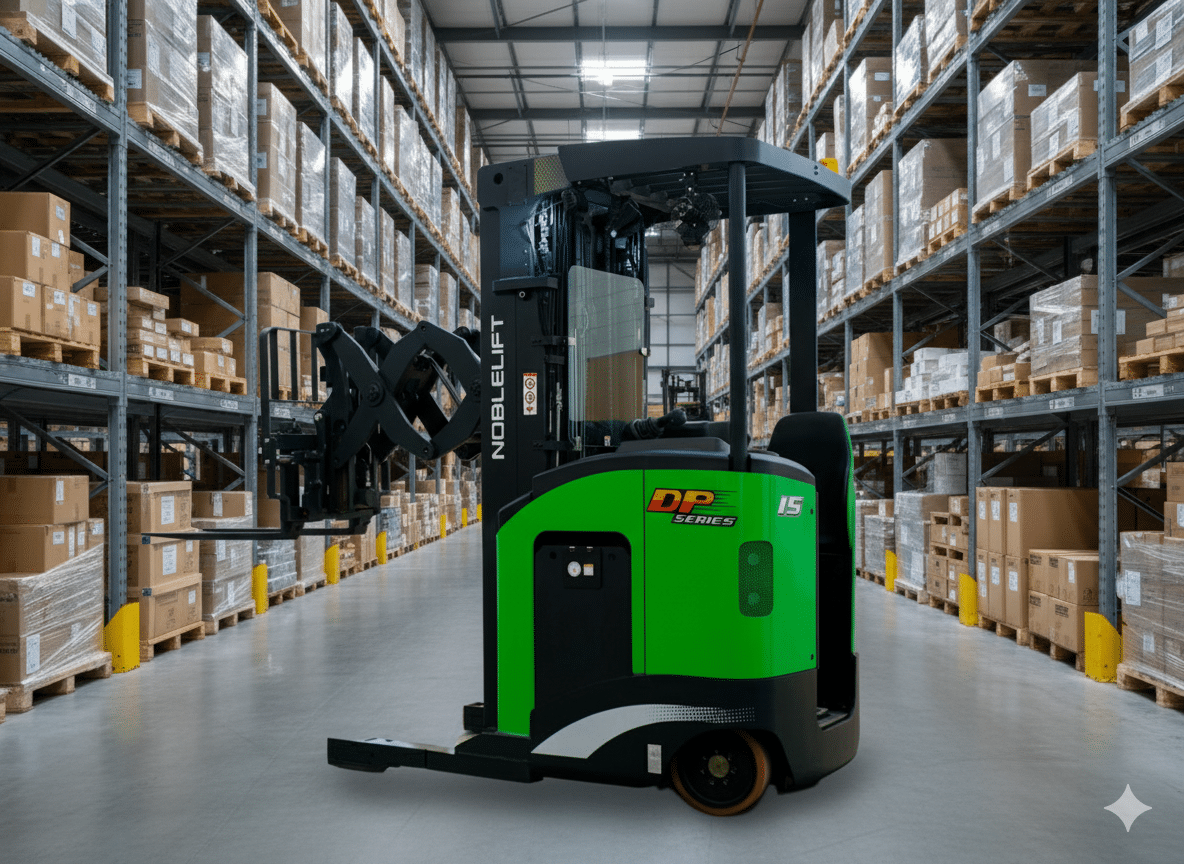
Now, we move into the realm of the specialists. A reach truck is designed for one primary purpose: to operate in very narrow aisles (VNA) and place pallets at extraordinary heights. Unlike a counterbalance forklift that carries its weight at the back, a reach truck uses outrigger legs at the front for stability. Its key feature is a “reach mechanism,” typically a pantograph, that extends the forks forward—or “reaches”—into the racking to deposit or retrieve a pallet. The entire mast does not tilt; only the forks extend. The operator stands or sits sideways, providing a clear view when traveling in either forward or reverse, which is essential for navigating long, narrow aisles.
Key Advantages of a Reach Truck:
- Extreme Space Optimization: Reach trucks can operate in aisles as narrow as 8 to 9 feet, a significant reduction from the 12 to 13+ feet required by a traditional counterbalance forklift. This allows for more racking to be installed in the same warehouse footprint, dramatically increasing storage density.
- Exceptional Lift Height: They are engineered to be incredibly stable at height, with some models capable of lifting pallets well over 30-40 feet, far exceeding the capability of most standard forklifts.
- Double-Deep Racking Capability: Some reach truck models are equipped with extra-long reach mechanisms that allow them to place pallets in “double-deep” racking systems (two pallets deep from the aisle), further maximizing storage density.
Beyond the Counterbalance: The Order Picker – Revolutionizing Piece-Picking
The second specialist, the order picker, addresses a completely different challenge: fulfilling orders that consist of individual items or cases, not full pallets. E-commerce has made this “piece-picking” process a critical part of most distribution centers. An order picker is a unique machine where the operator stands on a platform that moves up and down with the forks. This allows the operator to ascend to the rack level, step onto the pallet (which is secured on the forks), and manually pick the required items. It essentially functions as a mobile, high-reaching elevator for order fulfillment.
Key Advantages of an Order Picker:
- Unmatched Picking Accuracy: By bringing the operator directly to the product’s location (the “SKU”), the chance of picking the wrong item is drastically reduced. The operator is at eye-level with the product, can verify part numbers, and handle items carefully.
- Enhanced Operator Safety: It eliminates the dangerous and inefficient practice of operators climbing on racking or using unsafe ladders to reach products on higher shelves. The operator is always secured on a stable, guarded platform.
- Increased “Less-Than-Pallet” Productivity: For businesses that ship many small, mixed-item orders, the order picker is exponentially faster than bringing a full pallet down with a forklift just to pick one or two boxes off it.
FAQ
Conclusion:
The journey “Beyond the Counterbalance” is not about replacing the trusted workhorse of the warehouse, but about augmenting it with a team of specialists. The modern, 4-wheel lithium-ion counterbalance forklift has evolved into a powerful, efficient, and technologically advanced machine that serves as the perfect foundation for any material handling fleet. It is the go-to solution for loading, unloading, and general transport.
However, to achieve peak efficiency in the modern logistical landscape, we must deploy the right tool for the right job. When the goal is to maximize storage density and conquer vertical space, the reach truck is the undisputed champion of the narrow aisle. When the objective is to accurately and safely fulfill granular, multi-item orders, the order picker provides a solution that is simply unmatched in its productivity. By creating a blended fleet—combining the foundational strength of the counterbalance with the specialized prowess of reach trucks and order pickers—businesses can build a truly optimized, safe, and highly productive warehouse ecosystem ready to meet the challenges of today and tomorrow.
Call to Action:
Ready to explore how the right mix of counterbalance forklifts, reach trucks, and order pickers can transform your operation? Our team of experts is here to help you build the perfect fleet for your unique needs.
For more information or to arrange a consultation, please contact Liftway:
Contact Liftway today!
Brantford Location
- Address: 479 Brant County Road 18, Brantford, ON, Canada, N3S 0H4
- Phone: (519) 759-5590
- Email: sales@liftway.ca
- Website: Visit www.liftway.ca
Chatham Location
- Address: 54 Siemens Dr., Chatham, Ontario N7M 6M5
- Phone: (519) 354-1526
- Email: sales@liftway.ca
- Website: www.liftway.ca/liftway-chatham-forklifts-sales-service/